


Home
Noticias

IMB-CNM secures funding for an EIC Pathfinder project on neurotechnology and advanced materials
Researcher Anton Guimerà leads IMB-CNM's contribution to POLARIS, an ICN2 led project that aims to overcome technological challenges in neural interfaces for the brain

La microelectrónica fue parte de una noche donde el objetivo es aprender
Investigadores del IMB-CNM participaron en diferentes actividades de la Noche Europea de la Investigación en el CosmoCaixa de Barcelona, acercando la microelectrónica al público a través de conversaciones, microcharlas y talleres.
Agenda
Highlights

The FLASH biological effect in radiotherapy has been observed to appear at ultra-high dose rates UHDR (> 40 Gy/s), where the accurate dosimetry at such high rates is still a challenge. A new 4 × 4 array of SiC-based detectors (1 mm diameter, 2.2 mm pitch) is proposed for dosimetry in UHDR, as well as the feasibility of a position sensitive technology demonstrator covering 7 × 7 mm2 placed on a movable micro-stage to cover larger surfaces. In the ElectronFlash LINAC at the Institute Curie, two silicon carbide prototypes (a 2.2 mm diameter single diode and a 4 × 4-array of 1 mm diameter with a pitch of 2.2 mm), biased at 0 V, are exposed to a 0.5–5 𝜇s pulsed electron beam of 7 MeV alongside a flashDiamond PTW as reference dosimeter to characterize their response, time structure and position response. A linearity better than 3.5% is observed up to 10 Gy per pulse of the single diode device only limited by the reference dosimetry. The pulse structure measured is consistent with the reference beam current transformer installed in the LINAC, allowing for instantaneous pulse discrimination at UHDR and its verification in the measurement point. Moreover, results demonstrate the viability of using SiC arrays to quantify the dose per pulse in a 70 × 50 mm2 area with a granularity of 1 × 2.2 mm2, paving the way to larger arrays and thus toward potential 2D dose monitoring. The possibility of a position sensitive SiC dose monitor for UHDR is demonstrated, as the technology demonstrator has been proven to maintain good linearity up to at least 10 Gy per pulse, with a time resolution enough to observe microsecond pulses and position sensitive readout.
, , , , . Small dose monitor based on silicon-carbide diodes for FLASH radiotherapy. Med Phys. 2026; 53:e70354. https://doi.org/10.1002/mp.70354
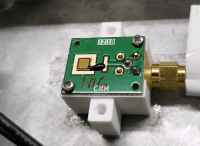
Accurate neutron detection in mixed photon-neutron and pulsed radiation fields is technically challenging, impacting industrial and medical applications. This paper presents the first measurements of thermal neutrons in conventional radiotherapy accelerators using a silicon carbide (SiC) P–N diode with different neutron converters. SiC detectors enable real-time estimation of secondary thermal neutron contributions, crucial for emerging radiotherapy techniques requiring precise neutron fluence monitoring. Beyond medical applications, the presented detectors show potential for neutron dosimetry, radiation monitoring, nuclear safety, and scientific research. The SiC diode active detection layer is less than 30 µm thick, and provides excellent gamma rejection, allowing discrimination of neutrons-induced events in mixed radiation fields. Experimental tests conducted on a TrueBeam radiotherapy LINAC demonstrated a thermal neutron detection efficiency of (4.32 ± 0.02)% for a (50 ± 10) µm thick LiF neutron converter. The detector, placed at 1.2 m from the accelerator isocenter, was used to measure neutron fluences at different monitor unit (MU) rates, ranging from 100 to 600 MU/min, with the LINAC operating at 15 MV. Under these conditions, the detector exhibited good linearity, without saturation or dead time effects.
Sci Rep 15, 30543 (2025). https://doi.org/10.1038/s41598-025-13052-w