


New silicon carbide devices can detect some of the unwanted radiation in radiotherapy
Developed at the CSIC's Institute of Microelectronics of Barcelona, they have been successfully tested in standard LINAC radiotherapy accelerators. They offer promising capabilities for many applications, such as neutron dosimetry, radiation monitoring, nuclear safety, and scientific research
A research led by the CSIC’s Institute of Microelectronics of Barcelona (IMB-CNM-CSIC) has successfully evaluated the use of silicon carbide (SiC) detectors to quantify the flow of secondary thermal neutrons in conventional radiotherapy. This advance would help identify some of the unwanted radiation in treatments and reduce the potential risk.
The relevance of these new devices, compared to the current silicon-based ones, is that they are more resistant and can operate in very high radiation conditions, which means they can have a longer average life.
"The detectors implemented in this research," say the authors in the article, "offer promising capabilities for a wide range of applications, including neutron dosimetry, radiation monitoring, nuclear safety, and scientific research."
This development, funded by the European Union and the Spanish Nuclear Safety Council (CSN), represents an important step toward the design and production of silicon carbide (SiC) neutron detectors in the Micro and Nanofabrication Clean Room at IMB-CNM-CSIC, the main node of the Micronanofabs Unique Science and Technology Infrastructure (ICTS).
The study, published in Nature's Scientific Reports, was led by Martín Pérez, a postdoctoral researcher with a Marie Curie fellowship at the IMB-CNM-CSIC, and involved the participation of researchers from the same center: Felipe Zamorano, Celeste Fleta, Marcio Jiménez, Gemma Rius, and Giulio Pellegrini, all led by Consuelo Guardiola.
Other participants included Philippe Godignon, formerly at IMB-CNM-CSIC; Carles Muñoz-Montplet and Diego Jurado-Bruggeman, from the Institut Català d’Oncologia (ICO), the Hospital Universitari de Girona Doctor Josep Trueta, and a group from the CSIC's Institute of Materials Science of Barcelona (ICMAB-CSIC) led by Pablo Guardia.
A promising material
The new device, a SiC diode combined with different neutron-converting materials, is an alternative capable of replacing both silicon semiconductor-based detection systems and traditional detectors that use helium-3 in very high radiation environments.
“Silicon carbide, explains Martín Pérez, is much more resistant to radiation and high temperatures than silicon, and is easier to obtain than helium-3. It is also a more accessible and economical alternative to diamond, another material used in the manufacture of this type of detector.”
Detecting secondary radiation
Detecting neutrons is crucial for applications in radiotherapy, as well as scientific and industrial applications. The study has carried out the first measurements of thermal (low-energy) neutrons produced by standard linear radiotherapy accelerators (LINAC).
LINAC accelerators produce photon beams to treat tumors. One drawback is that, above a certain energy level (about 8 MeV or mega electron volts), unwanted secondary neutron radiation is generated that is not useful for treating the tumor and can instead damage surrounding healthy tissue. It should be noted, Consuelo Guardiola points out, that “in general, less than 0.5 MeV (which are in fact X-rays) are usually used for superficial tumors, and between 4 and 15 MeV (photons) are used for deeper tumors. Treatments using more than 8 MeV can produce neutrons as secondary particles in the accelerator head, although the flow depends on the accelerator model, treatment technique, or number of fields, among other factors.” Therefore, knowing this neutron dose is essential to ensure safe radiation doses.
The detectors have been tested with a LINAC accelerator operating at 15 MV, and the thermal neutron flux around the stretcher where patients would be located has been measured, successfully measuring thermal neutron levels at different energies and radiation dose rates.
"This allows us to know the secondary dose from neutrons and thus assess whether more than the tolerable dose is being delivered. This work has been the starting point for testing the device in more advanced modalities,” notes Consuelo Guardiola.
Under all conditions, the detector showed a linear response, with no signs of saturation or data loss, and high efficiency. The devices were designed and manufactured at IMB-CNM-CSIC, one of the few centers in the world with the experience and technological infrastructure in its Clean Room to manufacture silicon carbide devices for radiotherapy. The readout electronics were developed at IMB-CNM by Martín Pérez. All measurements were performed at the Hospital Universitari de Girona Doctor Josep Trueta.
For its part, the ICMAB-CSIC team has developed lithium conversion layers to coat the device, which react exclusively to the presence of neutrons and generate a detectable signal that can be used to reveal and quantify the neutron flux.
These detectors allow real-time monitoring of secondary thermal neutrons, which is essential for new types of radiotherapy that require instantaneous measurements. For example, explains Martín Pérez, “these detectors can maintain good performance even when subjected to high and repeated doses of radiation, which is essential for establishing accurate and reliable dosimetry in radiotherapy.”
In addition, these type of devices can also be used to make comparisons between different accelerators, establish the shielding that the room should have according to the level of radiation, or other applications in the field of nuclear safety.
This project has received funding from the European Union's Horizon 2022 research and innovation program.
This project has received funding from the European Union's Horizon 2022 research and innovation program under Marie Sklodowska-Curie grant agreement No. 101106191 and from the Nuclear Safety Council (CSN), project Grants 2022 SUB-08.
Reference article: Martin Perez et al. Evaluation of a silicon carbide P-N diode for thermal neutron detection in a radiotherapy LINAC. Scientific Reports, (2025) 15:30543 | https://doi.org/10.1038/s41598-025-13052-w
Gallery


- Readout electronics for the measurement system.
- Silicon carbide diode mounted on a custom printed circuit board (PCB).
- Optical microscope image of the detector.
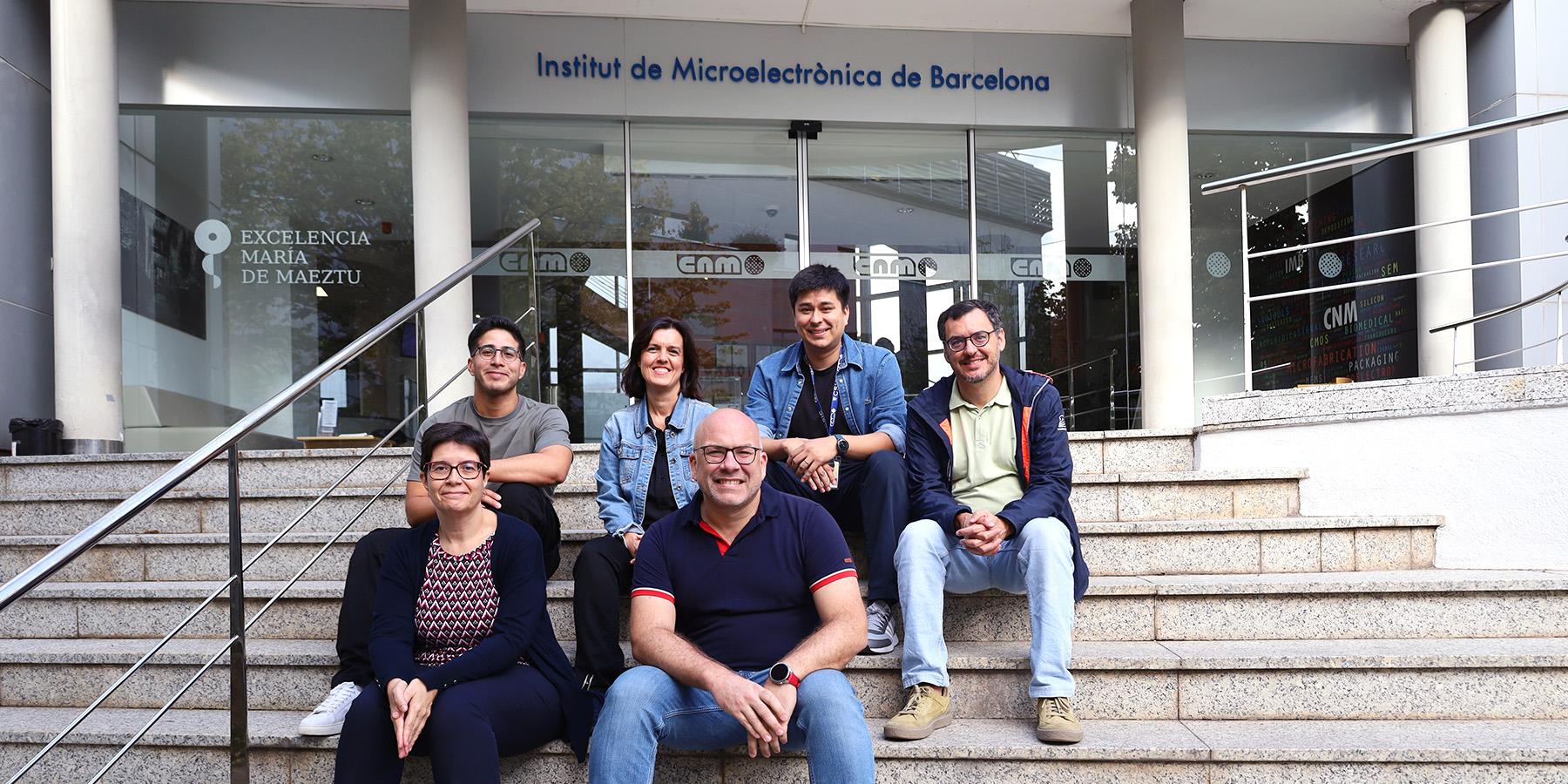
- IMB-CNM and ICMAB team members who authored the paper: Celeste Fleta, Marcio Jiménez, Consuelo Guardiola, Martín Pérez, Felipe Zamorano, and Pablo Guardia.
Detecting neutrons is crucial for applications in radiotherapy, as well as scientific and industrial applications. The study has carried out the first measurements of thermal (low-energy) neutrons produced by standard linear radiotherapy accelerators (LINAC).