


IMB-CNM celebrates emerging scientific talent at Young Researchers Day 2026
The fourth edition brings together predoc and postdoctoral researchers to share innovation and excellence in microelectronics and nanoscience, with almost 50 contributions. Awards were sponsored by D+T Microelectrónica, Electroseek, INBRAIN Neuroelectronics, Energiot, and AiQUOS
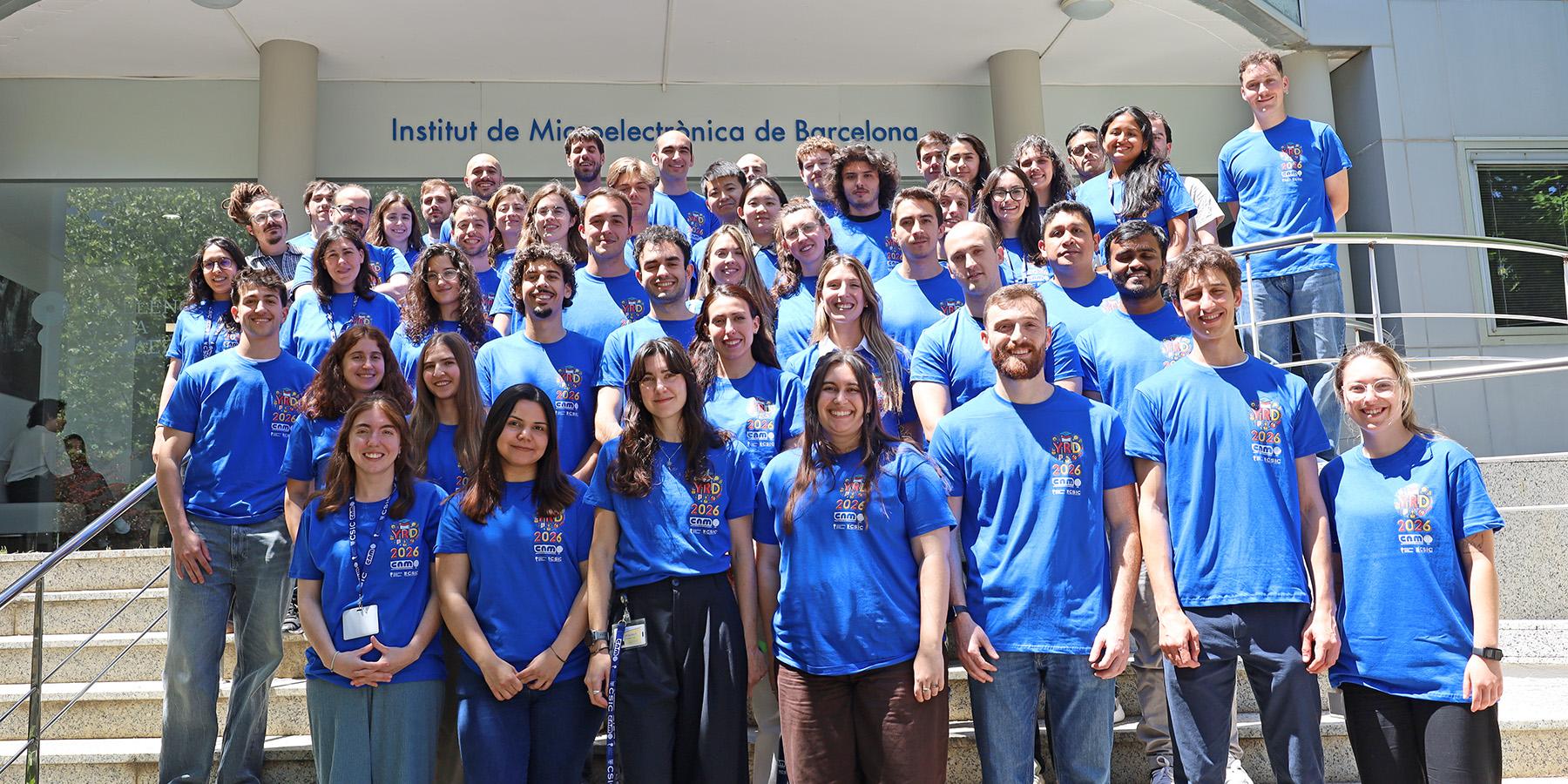
The IMB-CNM marked a new edition of its Young Researchers Day by placing early-career scientists at the centre of the conversation. The fourth edition of the event, celebrated at the institute' premises on May 21, reinforced its mission: to create a vibrant space where predoctoral and postdoctoral researchers present their work, exchange ideas and strengthen connections across disciplines.
This year, participants delivered 46 oral contributions, including 36 presentations by predoctoral researchers and 10 by master' students; 10 postdoctoral researchers also showed one poster about their research. It highlighted the diversity and quality of ongoing research at the institute. The program reflected both the depth of scientific inquiry and the strong engagement of the young research community.
The event counted on the support of the following sponsors: companies D+T Microelectrónica and Electroseek.com, and spin-offs INBRAIN Neuroelectronics, Energiot, and AiQUOS. Four IMB-CNM senior researchers in different fields evaluated the presentations, Jorge Barreto (photonics), Gemma Gabriel (biotech), César Fernández (biosensors), and Marta Fernández (quantum technology).
YRD was organized by both the Predoctoral Committee together with two representatives of the postdoc collective: Carla Blanes Gallego, Florent Dougados, Sandra Pérez Jiménez, Gabriele Petitto, Carla Riera Llobet, Iker Uranga Granados, Flaminia Vinci, and Eva Maria Deltor Cortés; plus Neil Moffat and Carlo Pepe. They coordinated the program and played a key role in ensuring the success of the event. IMB-CNM would like to thank them for their outstanding initiative and dedication.
Awards for the best contributions
IMB-CNM also recognized excellence with awards for the best presentations and posters, the best communicator and the person with the most attention (winner of the final quiz). The research prizes were selected by a combined vote of members of the jury and the audience. The awardees were as follows:
Oral presentations
- 1st Best Oral Contribution: Núria Termes, for Tattoo Electrodes for High-Density Superficial Electromiography (HD-sEMG)
- 2nd Best Oral Contribution: Núria Barrera, for Validation of a multisensor system for monitoring macronutrients in horticultural applications
- 3rd Best Oral Contribution: Aida Visús, for Study of Electrochemical Processes in Silk-Based matrices
Best poster
- Carlo Pepe, for Ion Irradiation for Scalable Integrated Superconduting Circuit
Best final thesis of the master's (TFM)
- Biel Segura, for Developement of electrospun fibers for piezoelectric and triboelectric energy harvesting devices
Best communication
- Haowen Hu, for Polymeric precision doping assisted by high-resolution block copolymers
Quiz
- Jordi Antoja
Technology and Sensors Session
- Haowen Hu: Polymeric precision doping assisted by high-resolution block copolymers
- Gabriele Petitto: Single-Electron Transistors for Quantum Computing Applications
- Marc Julià: Optical and Electrical Co-Simulation of Waveguide-Integrated LGAD Photodetectors
- David Valero: Fabrication and characterization of silicon strip particle detectors
- Teresa Elenes-Cervantes: Advanced electronics via infiltration of self-assembled nanomaterials
- Lorenzo Tincani: Fabrication and characterization of 3D timing detectors
- Sergi Valero: Towards cleaner graphene interfaces in graphene FETs
- Laura Bono: Stability and degradation of gSGFETs for biomedical applications
- Nerea Alvarez de Eulate Llano (becaria Fundación "la Caixa"): Graphene-based microtransistor neural arrays for simultaneous MRI and DC-coupled electrophysiology
- Marcel de la Vega: Direct Growth of Graphene Ribbons (GRs) and their integration for nanoelectronics
- Juan Ignacio Drovandi: CMOS monolithic sensors for particle detection and imaging applications
- Júlia Sancho Tapia: Spectroscopic reflectometry (Nanospec II)
- Amalia Arias Perez: Silicon-based radiation sensors and dosimeters for safety and CBRNe applications
- Núria Termes: Tattoo Electrodes for High-Density Superficial Electromiography (HD-sEMG)
- Zhenhua Su: Memristors based on high-k dielectric and organic materials
- Roger Solé Vilajuliu: Sustainable Circuits for BAN-Based Health Wearables
- Maria Hadid: From graffiti to energy: spray-deposited batteries for IoT systems
- André Dias: Integrating Microchannel Cooling in an All-Si-Ladder Radiation Detector Prototype
- Yara Mahboub: Gate-defined Single Electron Transistors
- Alejandro Gil: Ion Implantation Trimming of SiN for Photonic Integrated Circuits
- Florent Dougados: Development of Low Gain Avalanche Detectors for particle physics and medical applications
Health and Environment Session
- Flaminia Vinci: Compact Microfluidic System for Automated Biomarker Monitoring based on Glass-Microarrays
- Carlos Alvarez: Organic Chemosensory Neural Network for Cognitive Health Tracking
- Sandra Pérez Jiménez: Selective Functionalization of Graphene Solution-Gated FETs for High-Throughput Multisensing
- Orlane Nicolardot: Microbatteries for autonomous detection of events in biological environments
- Núria Barrera: Validation of a multisensor system for monitoring macronutrients in horticultural applications
- Aida Visús Martínez: Study of Electrochemical Processes in Silk-Based matrices
- Carla Blanes Gallego: Biocompatible Electrospun Membranes for Green and Smart Biosensing
- Andrea Sanchís Moltó: Development and simulations of SiC microdosimeters for FLASH Radiotherapy
- Jitendra Kumar: Neuromorphic Electrochemical Imagers for Advanced Organ Modeling and Medical Discovery on Chip
- Nuan Zhang: Sustainable functional forestry residues for manufacturing electrochemical sensors
- Juan Campoverde: Integrated CMOS ASIC for Radiation Observation in flash operation (ICARO)
- Laia Bagur Carrasco: Multi-cell 3D in vitro model with integrated piezoelectric scaffolds for skin tissue engineering
- Ferran Delgà: Digital Neuromorphic Processor Unit Design for Extreme-Edge AI Sensor Systems
- Alex Fulleda: Multi-Timescale Conductance (MTC) Spiking Networks
- Pol Ainoza: Optimization of a Readout ASIC based on graphene transistor for neural applications
- Cristina Vaca Chanatasig: Magneto-electric nanosystems for wireless cell stimulation
Energy and Mobility Session
- Conrad Ferrer Falces: Local stress analysis of IGBTs in Induction Cooktops
- Marc Aceituno: Development of Nanostructured Thin-film based Micro Thermoelectric Generators (uTEGs) for autonomous powering of IoT nodes
- Ziyin Sun: Chip embedding: Integration of power devices directly into PCBs
- Biel Segura: Development of electrospun fibers for piezoelectric and triboelectric energy harvesting devices
- Pierre Gallarday: Demonstration of Homoepitaxial Gallium Oxide PiN Diode via Phosphorus Implantation
- Aniol Vellvehí i Llovet: Development of advanced ultra-wide bandgap devices based in gallium oxide for high power electronics
Fundamental Physics and Quantum Session
- Maria Benito: Proximity effects of thin Ti/Al bilayers in superconducting CPW resonators
- Mihaela Floruc Darie: Simulation of semiconductor nanoelectronic devices based on single dopants
- Jack Nickson: Advanced wide band gap semiconductor devices for particle detection in high energy physics and space applications
Posters
- Carlo Pepe: Ion Irradiation for Scalable Integrated Superconduting Circuit
- Neil Moffat: Development of Single Photon Avalanche Detectors
- Aritz Lafuente: Opto‑Magnetically Guided Monocytes for Enhanced Nanotherapy in 3D Bioprinted Tumor Models
- Xavi Fernández-Tejero: Monolithic integration of cooling microchannels in silicon wafers with Back-End Of Line (BOEL) layers
- Alexandre Moreno: New sensors based on microelectronic technologies for cell culture monitoring
- Sandra Pérez Rafael: Development and Optimization of Zinc and Molybdenum Bioresorbable Conductive Inks for Printed Transient Electronics
- Pablo Fernández: From MOSFETs to CERN: An (un)conventional research path
- Laura Lefaix Fernández: Self-powered piezoelectric microdevices for wireless electrical stimulation of cells / Customizable micropattern design of ZnO nanosheets on silk fibroin/gelatin films for biocompatible piezoelectric actuation
- Marc Tudela Pi: Electrical Characterization of Graphene Solution- Gated Transistors for Safe and Low-Noise Neural Recording
- Helena Lozano: PTI Ciencia Digital
Best Prizes


Oral contributions


About the event


Gender assessment
In terms of gender distribution, a total of 46 oral contributions were delivered, of which 20 were presented by women and 26 by men. Women therefore accounted for 43% of the total, a slightly higher proportion than that observed across IMB-CNM overall. Regarding predoctoral presentations, there were 36 in total, with a near gender balance: 19 were presented by men and 17 by women. In the Master’s section, 10 oral contributions were recorded, 7 of which were delivered by men and 3 by women. Additionally, 10 posters were presented by postdoctoral researchers, with participation distributed as 7 men and 3 women. In terms of the jury, it was formed by 2 women and 2 men.
At IMB-CNM, women currently represent 38% of the total staff, a proportion that decreases slightly when considering only research personnel. Across the Spanish National Research Council (CSIC), data from the 2024 Mujeres Investigadoras Report indicate that women constitute 42,9% of researchers across all career stages. However, this figure declines to 26,9% at the level of research professors, which represents the highest academic rank. Among predoctoral researchers, women account for 51.3% of the total. Notably, within the sub-area of Physical Sciences and Technologies, which includes IMB-CNM, the proportion of women is significantly lower, at 23,7%.