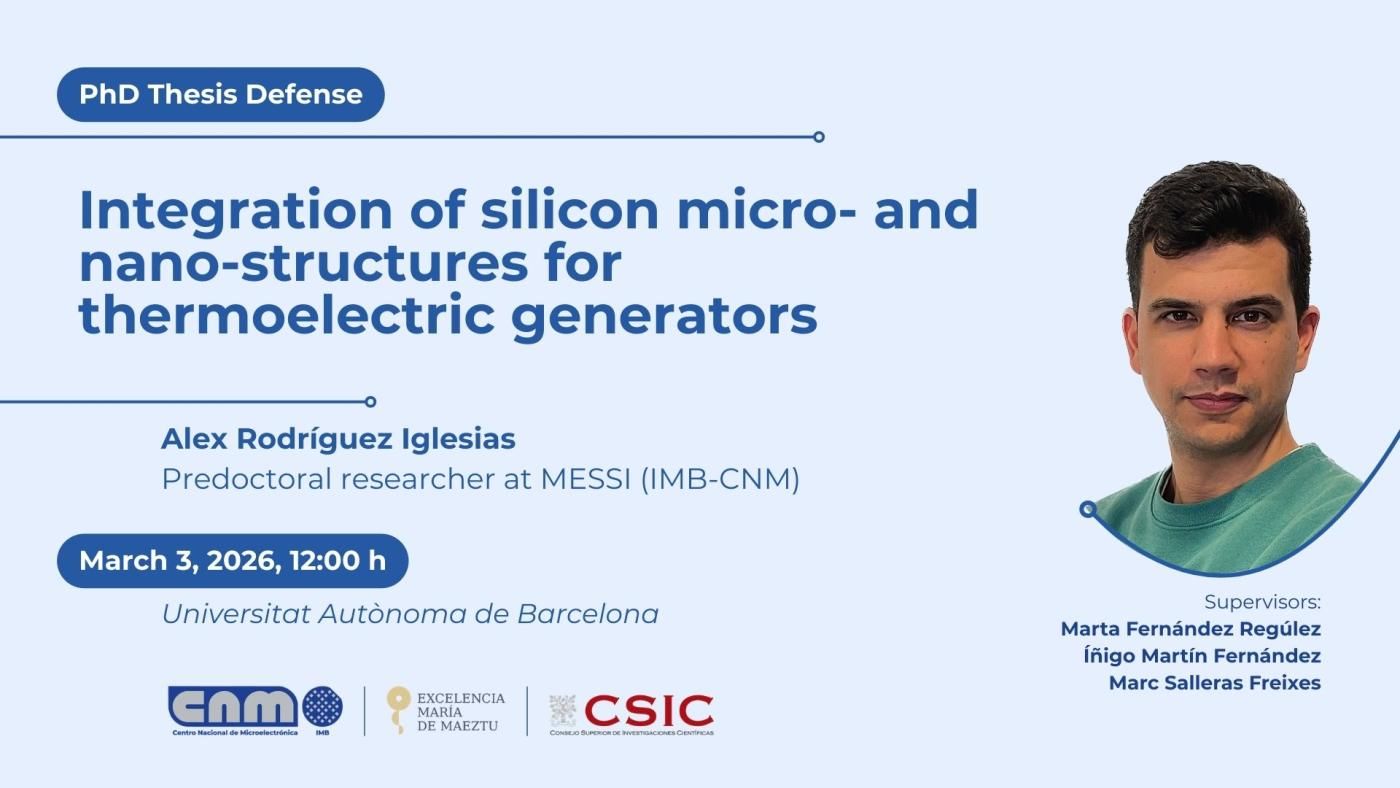
PhD Thesis Defense by Alex Rodríguez Iglesias, predoctoral researcher at IMB-CNM
Supervisors:
- Marc Salleras
- Íñigo Martín
- Marta Fernández
Members of the Jury:
- Dr. Giovanni Pennelli (Università di Pisa)
- Dr. Marianna Sledzinska (ICN2)
- Dr. Olga Caballero Calero (IMN-CNM, CSIC)
University: Universitat Autònoma de Barcelona
About the thesis
Harvesting environmental energy sources to meet the growing demand of electronic devices is a key challenge in reducing the environmental footprint of our society. Among the available sources, heat offers a promising future due to its ubiquitous presence as a byproduct in industry, transportation and energy-related processes. In this context, thermoelectric generators stand out as a route to convert heat into electricity. Nonetheless, the current use of thermoelectric generators remains significantly limited because most commercial devices are based on expensive and toxic materials. Therefore, alternative materials must be explored. Silicon is a prominent choice due to its abundance, non-toxicity, and excellent integration and miniaturization capabilities. However, the high thermal conductivity of bulk silicon limits its thermoelectric efficiency. To make silicon viable in thermoelectric applications, this challenge must be addressed. The objective of this thesis is to investigate the potential of silicon as a thermoelectric material by exploring various micro- and nanostructures in terms of their properties and energy harvesting capabilities. These structures include silicon microbeams, nanowires, and nanostructured thin films fabricated via block copolymer pattern transfer.